Scritchy Scratchy
- 4.8
- Rating
- 100.00K
- Installs
- $6.99
- Price
 Analysis by App-foxy
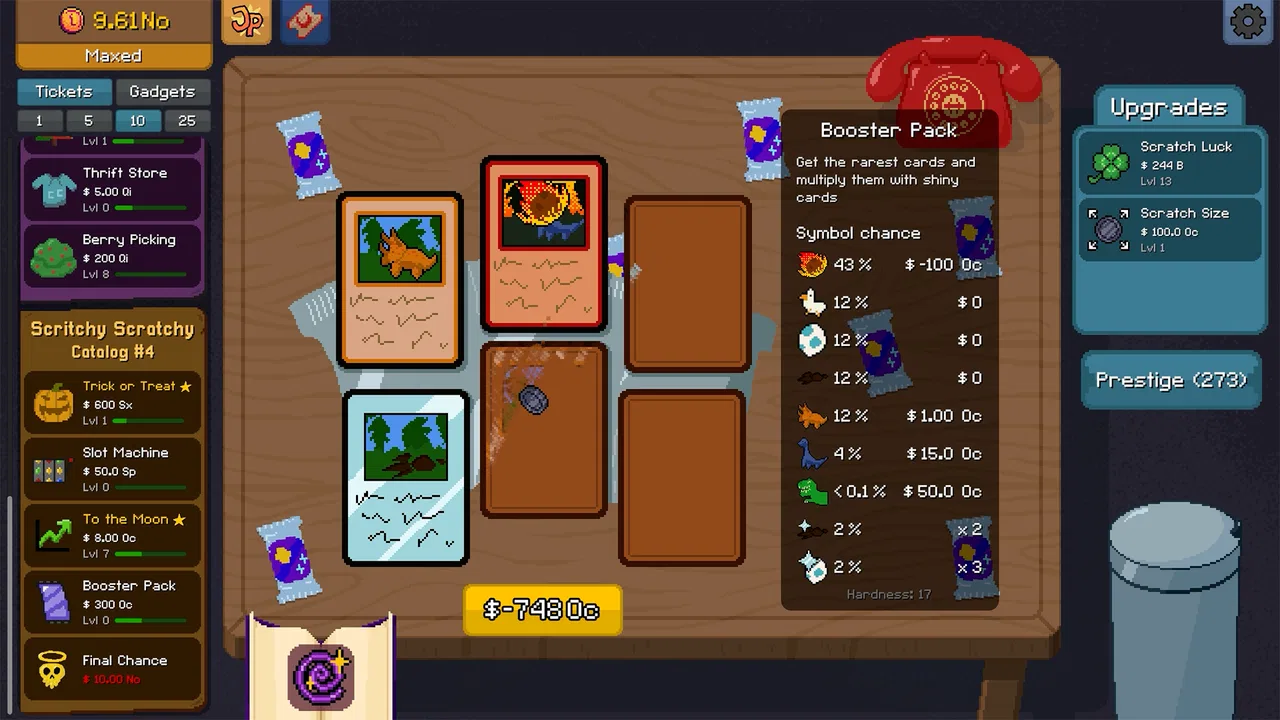
I went into Scritchy Scratchy expecting a very small arcade distraction, and that is still the best way to understand it. It is a paid game from Funday Games ApS built around the familiar pleasure of revealing a scratch-off result, but it turns that simple action into a repeatable chase for larger jackpots. The appeal is immediate: buy a stack, scratch through it, collect the result, and decide whether the next ticket is worth your attention.
What surprised me is how much the experience depends on presentation rather than complex controls. There is no complicated movement system to learn and no large collection of menus to master. That makes it approachable for people who want a low-pressure game, while also exposing its main weakness: once the novelty of scratching fades, the underlying loop has to carry the whole experience. I found it most enjoyable in short sessions, especially when I treated it as a tactile arcade toy rather than a deep progression game.
How the game communicates its simple loop
I find that the game’s simple loop is easiest to judge by noticing how it shifts my attention: instead of mastering a control scheme, I watch each ticket become a result and decide whether I want another round. That makes the experience approachable, but it also puts extra weight on clear feedback and an easy stopping point. The next section looks at how those choices affect comfort in different play situations.
You May Also Like

 Blood Strike: 2.5 Anniversary
Blood Strike’s Loadouts Turn Every Drop Into a Tactical Gamble
A close look at Blood Strike’s custom loadouts: how fast access to signature weapons reshapes its battle royale rhythm, rewards preparation, and narrows the gap between fights.

 Pandora - Music & Podcasts
Pandora’s Music Is Easy to Start, but Harder to Recover
Pandora’s strength is its low-effort path from a seed to a station. Its weak spot is how much confidence it asks you to place in connection, setup, and quiet recovery.

 8 Ball Pool
 Is Built on Rivalries, Rematches, and Routine
A close look at the rivalries, rematches, shared routines, and unanswered safety questions that turn a quick pool match into a persistent mobile community.

 Samsung Music
’s Quiet Strength Is Playing What You Already Own
Its reach comes less from spectacle than from dependable access to a personal library. That simplicity is both the app’s strongest retention engine and its ceiling.

 AccuWeather: Weather Radar
AccuWeather Review: A Quick, Clear Forecast for Everyday Decisions
For everyday plans, the best forecast is the one you can understand quickly. AccuWeather makes rain timing, radar, and local conditions easy to act on, with a few trade-offs.

 Hill Climb Racing
Why Hill Climb Racing Still Turns Crashes Into One More Run
A tiny car, a bumpy hill and one more upgrade: Hill Climb Racing keeps resurfacing because its simple chaos makes every near-miss feel personal.
More From Our News Desk



Readable goals and a quick start
The central idea is easy to understand. You purchase scratch-offs, reveal them, and work toward bigger prizes. The store summary also points to auto-scratching, which changes the pace once it becomes available. That gives the game a natural contrast between active play and a more hands-off rhythm, although the satisfaction of manually revealing a ticket is clearly part of the intended charm.
I like that this structure does not demand a long tutorial or prior knowledge of arcade games. A player can understand the basic objective almost immediately. For someone who struggles with dense instructions, unfamiliar symbols, or multi-layered quest systems, that simplicity is a genuine advantage. The game asks you to focus on one repeated action instead of remembering a long chain of rules.
At the same time, a simple goal needs clear feedback. When a ticket produces a reward, the result should be instantly distinguishable from an ordinary miss, and the value of continuing should be understandable without forcing the player to inspect several screens. In my experience, this kind of game works best when the visual hierarchy keeps three things obvious: what I can buy, what I have won, and what action comes next.
Navigation that suits short sessions
The arcade format makes the game a reasonable fit for quick visits. I can imagine opening it while waiting for an appointment, taking a few turns during a break, and closing it without losing the thread of a long story. That is useful for players who find extended sessions tiring or who prefer games with a clear stopping point.
There is also a practical benefit for people who are easily overwhelmed by busy interfaces. A scratch-off game has a narrower information problem than a strategy title filled with maps, inventories, character statistics, and layered currencies. The fewer decisions on screen, the easier it is to scan the current state and choose an action.
Still, I would not assume that minimal gameplay automatically means perfect navigation. Repeated rewards, purchase choices, and progression prompts can become visually noisy if they compete for attention. I would personally keep an eye on whether the game makes the next action unmistakable, especially after a large win or when auto-scratching enters the flow. A short game should not make the player hunt for the button that continues the round.
How auto-scratching changes the experience
Auto-scratching is more than a convenience feature. It changes who the game may suit. Manual scratching gives the player a direct, repetitive interaction, while automation reduces the need to perform that action over and over. That can help when the physical gesture becomes uncomfortable, when a player wants to watch outcomes rather than create them, or when the novelty of the gesture has worn off.
My advice is to think of auto-scratching as a pacing tool rather than an automatic improvement. If the physical reveal is the main reason you enjoy the game, using it too early may remove the most satisfying part. If you are playing to manage a growing stack efficiently, automation may make the routine less demanding. The better choice depends on whether you value the action itself or the result at the end of each ticket.
Text, contrast, and visual attention
Readability matters unusually much here because the game is built around symbols, prize values, and revealed areas. I would want the important result to stand apart from decorative effects, particularly after several tickets have been opened in succession. Players with reduced vision may find small prize labels or low-contrast scratch details harder to interpret, even when the overall layout looks uncluttered.
Players who are sensitive to flashing effects, rapid visual changes, or celebratory animation should approach the game cautiously. A jackpot-focused arcade presentation naturally benefits from moments of excitement, but those moments can also make a session uncomfortable for some people. I would begin with a brief play session in a calm environment and stop if the visual feedback feels tiring rather than entertaining.
Playing comfortably across different abilities and situations
I think comfort here is about more than whether the controls are easy to learn. Repeated gestures, visual attention, and the pace of reward feedback can matter just as much, especially during a quick break or when someone else is sharing the device. I’ll look at those practical differences next, including when a slower, more deliberate session is the better fit.
Motor demands are simple, but repetition still matters
From a control perspective, the concept is much less demanding than an action arcade game. There is no need to steer through hazards, react to several threats at once, or coordinate multiple buttons. That makes it potentially suitable for players who prefer single-action interactions or who find fast reflex challenges inaccessible.
However, scratching is still a repeated gesture. A player with limited hand movement, tremors, joint pain, or fatigue may find manual play more difficult than the game’s simplicity suggests. The important distinction is between low complexity and low physical effort; they are not the same thing. Auto-scratching can reduce the repeated motion, but it does not necessarily remove every other interaction involved in selecting tickets, confirming choices, or moving through results.
A useful personal workflow would be to play with the device resting on a stable surface rather than holding it in midair. That can reduce unnecessary strain and make short taps or swipes more controlled. I would also avoid treating the game as something that must be played continuously. The loop is naturally suited to stopping after a few tickets, which is helpful when hand fatigue or concentration becomes an issue.
Different sensory preferences call for different pacing
Some players will enjoy the reveal itself: the gradual discovery, the suspense before a result, and the visual emphasis on a possible jackpot. Others may find the repeated anticipation stressful or simply boring after a while. Neither response is unusual. The game’s identity is tied closely to that reveal, so players who dislike chance-based suspense may not find the arcade framing enough to change their opinion.
I also think the game is better suited to quiet, controlled play than to environments where attention is divided. If the screen uses animation or prominent reward feedback, a noisy commute or bright public space may make it harder to follow the outcome. Conversely, the straightforward loop can work well during a calm break when the player wants something less demanding than a competitive game.
For players who need spoken information, large text, strong contrast, or reduced motion, the key question is whether the visual result can be understood without relying on decorative cues. I would not treat the absence of complex controls as proof that every sensory need is covered. The game’s accessibility is strongest at the level of interaction simplicity, not necessarily at every level of presentation.
A realistic everyday use case
Imagine finishing a short break and having only a few minutes before returning to work or study. A large role-playing game would be awkward because it may require travel, inventory management, or remembering a mission. Scritchy Scratchy fits that moment better: open it, buy a manageable stack, reveal a few tickets, and stop. The session has a clear beginning and end, and there is no need to coordinate with other players.
That same scenario shows why I would set a personal limit before playing. Because the game revolves around buying more scratch-offs and chasing larger jackpots, it can encourage “one more ticket” thinking. I would decide in advance how long I want to play and how much of the in-game purchasing loop I am comfortable using. The paid entry price is listed as $6.99, and additional in-app items range from forty-nine cents to $17.99, so the purchase structure deserves attention rather than being treated as an invisible detail.
This is especially important for families. The content rating is Teen, not a child-focused designation, and the combination of scratch-off presentation and optional purchases may not be appropriate for every younger player. I would not hand it to a child without discussing the purchase controls and the difference between an arcade simulation and real-world gambling. The game may be playful, but the visual language of tickets and jackpots can still shape expectations.
What the game offers that alternatives do not
Compared with a conventional reflex-based arcade game, this one is calmer and more deliberate. There is no obvious need to master timing under pressure, memorize enemy patterns, or compete for a high score through rapid movement. That makes it a better choice for players who want an arcade label without the usual intensity.
Compared with a traditional digital lottery or scratch-card app, the game framing gives the activity a more playful structure. The presence of auto-scratching and the pursuit of larger jackpots make it feel designed as a repeatable game loop rather than a single occasional reveal. The trade-off is that the same loop can become repetitive more quickly than an arcade title with levels, varied challenges, or a changing world.
Compared with idle games, manual scratching gives me more immediate participation. I am not simply waiting for a timer to finish. Yet an idle game may be better for someone who wants progress with almost no interaction, while a skill-based arcade game may be better for someone who wants outcomes determined by timing or accuracy. This title sits between those options: it offers a tactile action, but the excitement comes from the result rather than from demonstrated player skill.
Where the purchase model affects accessibility
The cost is not only a financial question; it can also affect whether the experience feels comfortable and predictable. Players who need a fixed, one-time purchase may be uneasy with a game that also presents optional items. Players who are prone to impulse spending may find jackpot language and repeated ticket purchases particularly persuasive.
I would recommend turning on device-level purchase protections before letting anyone else use the game. I would also treat the listed item range as a reason to review every confirmation screen instead of tapping through automatically. That is a practical accessibility measure for people who have difficulty reading quickly, for children sharing a device, and for anyone who wants to avoid accidental purchases.
The best way to judge value is to ask how long the manual reveal remains enjoyable without extra spending. If the basic ticket loop already feels satisfying, the paid download may be easier to justify. If the fun depends on constantly buying more or reaching a particular jackpot, the experience may feel less predictable than a conventional arcade game with a fixed progression path.
Remaining barriers I would keep in mind
The biggest barrier is repetition. A player who needs variety, narrative development, or meaningful skill growth may run out of reasons to continue. The game’s loop is intentionally narrow, and that narrowness is both its strength and its limitation. It is easy to enter, but there may be fewer ways to stay engaged once the reveal itself stops feeling fresh.
Another barrier is the emotional design of chance. Even when the presentation is lighthearted, near-misses and jackpot chasing can create a cycle of anticipation that some players will not enjoy. This is not the right pick for someone looking for a reliably calming game, particularly if uncertain rewards make them anxious or encourage them to keep playing beyond their original plan.
There is also a difference between being easy to understand and being fully inclusive. A player may be able to learn the rules immediately but still struggle with small visual details, repeated gestures, fast reward animations, or purchase prompts. I appreciate the potential of auto-scratching, but I would not rely on it as a complete solution for every motor or sensory need.
Device compatibility is reasonably broad for an older phone or tablet, since the game requires at least Android 8.1. Even so, the experience may vary with screen size, display quality, and how comfortably a person can interact with the device. A larger screen could make ticket details easier to inspect, while a smaller handset may be more convenient for quick sessions but less comfortable for repeated gestures.
Who should try it, and who should skip it
I would recommend it to someone who enjoys scratch-card reveals, wants an arcade game without reflex pressure, and likes short sessions with a clear repeated action. It may also suit players who appreciate switching between manual interaction and a more automated pace. The game is particularly easy to explain to a friend because its central idea is visible almost immediately.
I would suggest skipping it if you want deep strategy, competitive skill, a story, or a wide range of activities. I would also be cautious if you dislike chance-based rewards, find jackpot themes uncomfortable, or prefer a firm one-time progression system with no optional purchases. In those cases, a level-based arcade game or a puzzle title with outcomes driven by decisions may be a better match.
The current version is 1.1.74, and the game has attracted an average rating of 4.8 from around 5.8 thousand ratings, with more than 100 thousand installs. Those figures suggest that the basic concept connects with many players, but they do not change my central advice: judge it by whether the scratch-and-reveal loop itself sounds enjoyable to you. Popularity cannot make repetition or chance appealing to someone who dislikes both.
My inclusive verdict
Scritchy Scratchy works best as a focused, low-complexity arcade experience rather than as a broad game you can play for endless variety. I like its immediate rules, its suitability for short breaks, and the possibility of reducing repetitive manual action through auto-scratching. Those qualities can make it more approachable than fast arcade alternatives for players who prefer slower interaction.
My recommendation comes with clear boundaries. Check whether the visual presentation is comfortable for you, be mindful of repeated scratching, and decide on a spending and session limit before the jackpot chase begins. The Teen rating and optional purchases also make it a game I would introduce carefully in a shared family setting.
For me, the strongest use case is a few deliberate minutes with no expectation of deep progression. If that sounds appealing, the $6.99 entry price may be reasonable for a compact arcade toy, provided you are comfortable with the additional purchase structure. If you need variety, strong accessibility controls, or skill-based outcomes, I would choose another category instead. This game is simple in a good way, but its simplicity needs to match your preferences rather than being mistaken for universal accessibility.
FAQs for Scritchy Scratchy
01What is Scritchy Scratchy, and how does the game work?
Scritchy Scratchy is a casual scratching game built around revealing hidden images or scenes by rubbing away a covered surface. Its simple tap-and-swipe controls make it easy to start, while the progressively changing artwork and objectives provide a relaxing reason to continue. Gameplay is generally designed for short sessions, making it suitable for quick entertainment rather than a long story-driven adventure.
02Is Scritchy Scratchy free to download and play?
Scritchy Scratchy can generally be downloaded without an upfront purchase, but the free version may include advertising, optional in-app purchases, or limitations on certain content. Before downloading, check the current store listing for the exact pricing model, available purchase options, and whether ads can be removed. Internet access may also be required for advertisements or selected features.
03Does Scritchy Scratchy require an internet connection?
The basic scratching interaction may work offline after the necessary game files have been installed, but this can depend on the version and device. Advertisements, analytics, updates, cloud features, or in-app purchases may require an internet connection. If offline play is important to you, test the game in airplane mode after installation and review its permissions and store description.
04Is Scritchy Scratchy suitable for children?
Scritchy Scratchy uses straightforward swiping mechanics and is likely easy for younger players to understand, but parents should still review the age rating and store information before allowing children to play. Advertising, purchase prompts, data collection, or occasional visual themes may affect suitability. Using parental controls and disabling unauthorized purchases is recommended, especially on shared family devices.
05Are there many levels, and does the game become repetitive?
The appeal of Scritchy Scratchy comes from its quick, satisfying reveal mechanic, but players who prefer complex strategy or deep progression may find the gameplay repetitive over time. Variety depends on the number of scenes, objectives, and unlockable designs included in the current version. Checking recent user reviews and update notes is useful for confirming how frequently new content is added.
Pros
- Simple scratch-off gameplay that is easy to learn and play casually.
- Short rounds make it suitable for quick breaks or on-the-go sessions.
- Satisfying scratch effects provide clear visual and tactile feedback.
- Lighthearted presentation makes it accessible for a broad range of players.
- Progression and unlockable content can encourage continued play.
Cons
- Gameplay may become repetitive after extended sessions.
- Some content or rewards may depend on watching advertisements.
- Limited strategic depth may not appeal to players seeking a challenge.
- Performance can vary on older devices
- especially with visual effects enabled.
- The game may offer less long-term value for players who prefer substantial campaigns.

Scritchy Scratchy
Gallery